2024-01-10
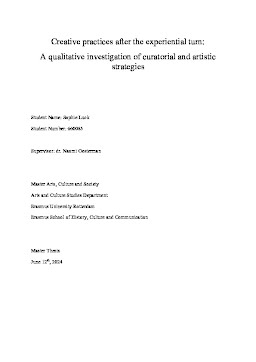
CREATIVE PRACTICES AFTER THE EXPERIENTIAL TURN: A QUALITATIVE INVESTIGATION OF CURATORIAL AND ARTISTIC STRATEGIES
Publication
Publication
Since the experiential turn, creating and distributing art needs to be socially justified, meaning it must serve a greater purpose. This turn led to an increasing trend of producing experiences that actively involve audiences, changing motivations and considerations in artistic and curatorial practices. Art is becoming performative, initiating dialogue and making audiences the primary focus. Therefore, the objective of the study is to address the research question: How do curators’ and artists’ design-thinking strategies cater towards audience experience through exhibitions? The study uncovers the strategies used by professionals to create dynamic and immersive environments because of this shift in priorities. Through in-depth interviews and thematic analysis of nine interviews with five artists and four curators based in Berlin, the research explores how they use various strategies to evoke curiosity, sustain interest, and provide a meaningful experience for their audience. The findings show that motivation and curiosity are central to design-thinking strategies. By introducing novelty and uncertainty, curators and artists capture audience interest, encouraging exploration and interaction. Furthermore, artist and curators exert their presence which provides immediate context and offers a personalized experience, highlighting the value of direct interaction in enhancing the art experience. Alongside exerting presence, curators and artists must be aware of their roles within an exhibition and consider how the space and community affect audience interpretation and engagement. This ensures that exhibitions are relevant, inclusive, and ethically sound. The findings also highlight the importance of variety-seeking tendencies and sensory-specific satiety in maintaining audience engagement. By integrating multiple sensory elements into exhibition design, curators and artists can prevent sensory overload, keeping the experience stimulating and educational. The research provides a comprehensive understanding of the multifaceted strategies employed by curators and artists to enhance audience engagement. It underscores the importance of balancing motivational strategies, presence, positionality, and sensory engagement to create meaningful and immersive art experiences. These findings offer valuable insights for future investigations into curatorial and artistic practices, particularly in the context of evolving audience expectations and the increasing demand for interactive and immersive art. The study also indicates that presence and sensory satiety theories from virtual reality and culinary arts, can be applied to the creation of art experiences.
| Additional Metadata | |
|---|---|
| Naomi Oosterman | |
| hdl.handle.net/2105/74814 | |
| Master Arts, Culture & Society | |
| Organisation | Erasmus School of History, Culture and Communication |
|
Sophie Luck. (2024, January 10). CREATIVE PRACTICES AFTER THE EXPERIENTIAL TURN:
A QUALITATIVE INVESTIGATION OF CURATORIAL AND ARTISTIC STRATEGIES. Master Arts, Culture & Society. Retrieved from http://hdl.handle.net/2105/74814 |
|