2025-10-10
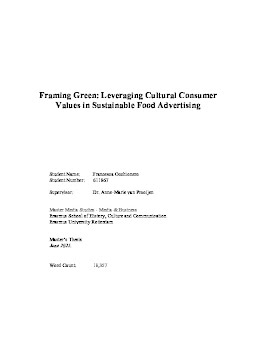
Framing Green
Publication
Publication
Leveraging Cultural Consumer Values in Sustainable Food Advertising
The growing urgency to address the current environmental crisis, accompanied by its significant social and economic impacts, demands new and innovative strategies to encourage individuals to adopt sustainable habits. Due to its universal necessity and position as one of the largest contributors to environmental degradation, the food industry offers a significant potential for change and targeted intervention. While past research has extensively studied how demographic variables influence sustainable behaviour, little attention has been paid to the role of underlying cultural values. Drawing on the Schwartz theory of basic human values, the present study investigated how advertising frames that emphasise specific values affect purchase intention for sustainable food products. This theory identifies two pairs of dichotomous value dimensions: self-enhancement versus self- transcendence, referring to whether goals focus primarily on the self or others, and conservation versus openness to change, regarding whether an individual prioritises stability or novelty. Using an unifactorial between-groups design, 235 responses were collected from participants from 35 countries through an online experimental questionnaire. Through random assignment, each participant was exposed to one of the four advertisements framed around one of the value dimensions, or the control. The outcome variables were product attitude and purchase intention. Results, however, indicate that there was no significant difference in purchase intention across experimental groups. When examining the direct effects of values, endorsement of self-enhancement and conservation values was unexpectedly positively associated with the outcome variables. For the former, this finding strongly deviates from previous literature which has frequently tied self-transcendence to sustainable behaviour. Further analyses indicate that value congruence, the alignment between participants endorsed values and those framed in the advertisement did not significantly affect purchase intention. Overall, the findings challenge assumptions related to Schwartz's value theory, framing theory, and value congruence, therewith providing novel practical and theoretical implications. Notably, the results suggest shifting target audiences from those motivated by concern for others, the environment, or openness to change, toward those driven by self-improvement, status signalling, and a desire for stability. Moreover, it suggests that value-based framing may be detrimental to the cause, possibly due to psychological mechanisms that make such frames appear broad, prescriptive, irrelevant, or exaggerated. Instead, it introduces the idea that advertisements framed without value-linked messages may be more effective. This suggests future research is needed to create effective tailored messages, potentially by combining values with demographic factors. Overall, these findings highlight the complexity of sustainable consumption and consumer decision-making, emphasising the need to consider a number of alternative variables in this phenomenon.
| Additional Metadata | |
|---|---|
| Anne-Marie van Prooijen | |
| hdl.handle.net/2105/76468 | |
| Media & Business | |
| Organisation | Erasmus School of History, Culture and Communication |
|
Francesca Occhionero. (2025, October 10). Framing Green: Leveraging Cultural Consumer Values in Sustainable Food Advertising. Media & Business. Retrieved from http://hdl.handle.net/2105/76468 |
|