2025-10-10
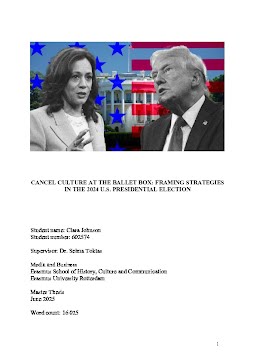
CANCEL CULTURE AT THE BALLET BOX: FRAMING STRATEGIESIN THE 2024 U.S. PRESIDENTIAL ELECTION
Publication
Publication
Abstract Cancel culture is one of the most polarizing phenomena in contemporary society. It originally emerged as a digital grassroots tool to hold individuals accountable for their harmful actions. However, the term has since evolved into a hot topic of debate across the political digital spectrum as some view it as a form of social justice, whilst others see it as a threat to individual rights This research investigated how cancel culture and related issues were framed by the different political parties on X during the 2024 presidential election in the United States. Moreover, this thesis examined the changing role of cancel culture in political communication and its usage by various political parties to shape public perceptions. To achieve this, it analysed 500 purposively sampled tweets from Democratic, Republican, and Independent-affiliated political figures and commentators using a two-stage qualitative method that combined inductive thematic coding with framing analysis. The study identified five dominant frames and found that the concept "cancel culture" itself was often deliberately avoided. This was most seen among Democratic-affiliated actors, who focused more on themes such as accountability and civic responsibility. Furthermore, Independent voices often challenged the dominant narratives presented by both major parties and offered alternative perspectives. Nevertheless, Republican actors reframed cancel culture as a threat to free speech and blamed this threat on the Democrats. These findings suggest that cancel culture has shifted from being a standalone cultural controversy to functioning as a flexible rhetorical tool embedded in broader ideological battles. The study also highlights how political actors change their messaging strategies in response to a quickly evolving discursive environment. Additionally, it illustrates how social media platforms like X enable real-time discursive shifts and allow actors to adapt strategic language to align with current political agendas. In doing so, cancel culture becomes a mirror of and a mechanism for broader partisan conflicts in the digital age.
| Additional Metadata | |
|---|---|
| Selma Toktas | |
| hdl.handle.net/2105/76628 | |
| Media & Business | |
| Organisation | Erasmus School of History, Culture and Communication |
|
Clara Johnson. (2025, October 10). CANCEL CULTURE AT THE BALLET BOX: FRAMING STRATEGIESIN THE 2024 U.S. PRESIDENTIAL ELECTION. Media & Business. Retrieved from http://hdl.handle.net/2105/76628 |
|