2025-10-10
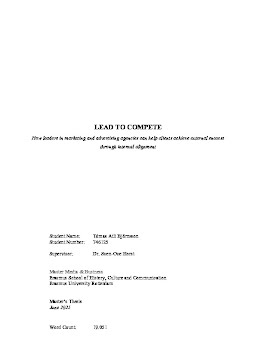
Lead To Compete
Publication
Publication
How leaders in marketing and advertising agencies can help clients achieve external success through internal alignment.
This research explores how marketing managers and agency leaders in Iceland employ leadership strategies to gain differentiation and distinction for clients. The focus is on how these strategies impact organizational culture by investigating how internal dynamics can influence desired external outcomes. The research is guided by the following research question: How do marketing managers in Iceland employ leadership strategies to maintain brand competitiveness and distinction for a client in their market and how do these leadership strategies impact their employees? This research is grounded in two key theoretical frameworks, one of which is transformational leadership, emphasizing vision, inspiration and motivation in leadership strategy. The other is leadership-as-practice (L-A-P) which views leadership as a collective process embedded in daily interactions. These frameworks are relevant in the agile and fast- paced environment of Icelandic marketing and advertising agencies due to the homogenous nature of Icelandic creative industries. A qualitative analysis was employed, using semi-structured in-depth interviews with leaders at agencies as well as their staff, to provide a reflection on the organizational culture. An additional reflective interview was conducted to reflect on themes that had emerged. A thematic analysis approach (TA) helped to inductively code and identify the following themes emerging from the data: leadership practice, culture, creativity, and branding practice. The study found a relationship between leadership style and the emergent organizational culture, which provided the basis for fostering a creative environment through strategic processes set by the leadership. This led to consistent and distinctive branding practices for clients of the agencies. Branding therefore emerged as an outcome of internal alignment and not as an isolated function. The findings therefore suggest that embracing and intertwining transformational leadership and leadership-as-practice strategies can assist leaders in aligning internal cultures to achieve desired external goals for themselves as well as clients. Offering valuable insight for practitioners to keep in mind when seeking a healthy client-relationship. Some limitations are due to a limited number of participants in Icelandic agencies, and the qualitative scope of the research. The findings may not be generalizable globally or to larger organizational settings. Future research could incorporate a multinational approach or explore leadership strategies.
| Additional Metadata | |
|---|---|
| Sven-Ove Horst | |
| hdl.handle.net/2105/76687 | |
| Media & Business | |
| Organisation | Erasmus School of History, Culture and Communication |
|
Tómas Björnsson. (2025, October 10). Lead To Compete: How leaders in marketing and advertising agencies can help clients achieve external success
through internal alignment.. Media & Business. Retrieved from http://hdl.handle.net/2105/76687 |
|