2025-10-10
More Than Human
Publication
Publication
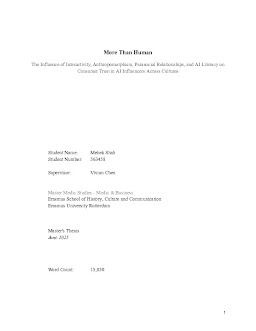
The Influence of Interactivity, Anthropomorphism, Parasocial Relationships, and AI Literacy on Consumer Trust in AI Influencers Across Cultures
As artificial intelligence (AI) influencers become more popular across social media channels, their potential for building consumer trust continues to be an unclear and challenging topic. Although AI influencers offer consistency, scalability, and new types of digital connections, their fabricated origin generates societal and ethical issues, and cognitive difficulties amongst consumers. This thesis looks at the psychological and cognitive factors which affect consumer trust in AI influencers, focusing on the contextual predictors of interactivity anthropomorphism, parasocial relationships (PSR), and AI literacy. Cultural environments is further explored as a significant moderating factor. This research, based on theories such as Parasocial Interaction Theory, the CASA paradigm, and Media Equation Theory, addresses the main research question: How do perceptions of and perceived relationships with AI influencers influence consumer trust? To answer this, a quantitative online survey was carried out with Qualtrics, focusing on adults that had engaged with influencers on social media platforms. The overall sample (N = 162) included respondents from 34 various nationalities. Respondents were shown images of AI influencers within lifestyle and fashion situations, and they answered pre-existing Likert-scale questions about interactivity, anthropomorphism, parasocial relationships, AI literacy, cultural environments, and consumer trust. Analysis of the data using IBM SPSS Statistics 29 provided several interesting and significant results. Firstly, PSR appeared as the most significant predictor of trust, emphasizing the emotional and psychological aspect of trust development with AI influencers. Additionally, AI literacy was shown to be positively correlated to trust, revealing that knowledgeable individuals are more assured and carefully aware in their evaluations. Surprisingly, perceived interactivity and anthropomorphism did not significantly predict trust, diminishing the idea that realism or reactivity solely can create trustworthiness. Lastly, the cultural environments had a strong and significant moderating effect on PSR and trust relationship, implying that cultural norms like individualism vs collectivism affect trust in AI influencers. These results have significant implications for marketers, AI developers, and educators. Businesses must focus more on presenting emotionally appealing storylines instead of artificial realism, as well as provide useful information that helps users grasp AI systems. Moreover, this study demonstrates that in an effort to foster genuine consumer trust, AI influencers need to culturally adapt to local consumers rather than being generic to worldwide consumers. As AI blurs the distinction between human and machine, these findings lead to a more ethical, efficient, and inclusive use of AI in digital marketing.
| Additional Metadata | |
|---|---|
| Vivian Chen | |
| hdl.handle.net/2105/76775 | |
| Media & Business | |
| Organisation | Erasmus School of History, Culture and Communication |
|
Mehek Shah. (2025, October 10). More Than Human: The Influence of Interactivity, Anthropomorphism, Parasocial Relationships, and AI Literacy on Consumer Trust in AI Influencers Across Cultures. Media & Business. Retrieved from http://hdl.handle.net/2105/76775 |
|